


Key Facts
- Taxpayers have spent more than $130 million on former presidents’ pensions, offices, staff, travel, and other benefits (excluding security costs) since 2000.
- Congress created these benefits in 1958 based largely on concerns about Harry Truman’s finances concerns that subsequent evidence has called into doubt.
- Modern former presidents have accumulated substantial wealth and can earn millions through book contracts, speaking engagements, and other media deals, further undermining the justification for generous taxpayer-funded office benefits for life.
- Senator Joni Ernst’s Presidential Allowance Modernization Act would cap pensions and expense allowances and reduce benefits for former presidents with substantial outside income.
- Congress should consider additional reforms, including stricter limits on office expenses, greater transparency over how funds are spent, and ending lifetime benefits after a reasonable transition period.
Introduction
Former presidents routinely earn millions of dollars from book deals, speaking engagements, media contracts, and other private ventures. Yet taxpayers continue to provide them with generous pensions, office space, staff, equipment, and other benefits for the rest of their lives.
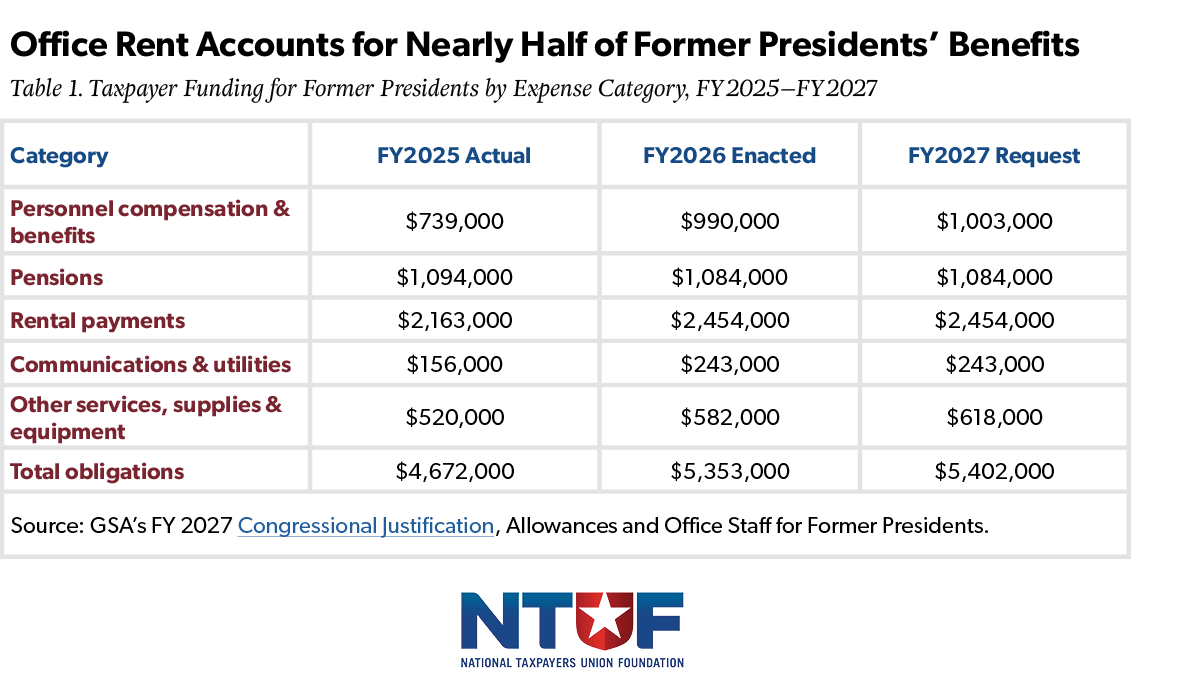
Since 2000, taxpayers have spent $134.9 million (in constant 2024 dollars) on these perks for former presidents. The FY 2027 budget request seeks $5.4 million for these pensions and perks. Nearly half of that amount—$2.5 million—would pay for office space, more than twice the amount requested for the former presidents’ pensions. These amounts exclude Security Service and other security costs that are not disclosed.
That may be a relatively small outlay compared to $7 trillion total federal spending, but expenses like this nevertheless add to the $40 trillion national debt. Moreover, they highlight a larger problem: Washington continues funding outdated benefits without seriously considering whether they remain necessary.
These perks were enacted in 1958 amid concerns about Harry Truman’s financial struggles that later proved to be unfounded. Today former presidents leave office with considerable personal wealth and extraordinary opportunities to earn additional income. There is little justification for taxpayers to continue subsidizing their offices without meaningful limits.
Congress came close to reforming these benefits in 2016, but President Barack Obama vetoed the legislation before leaving the White House. Senator Joni Ernst (R-IA) reintroduced the Presidential Allowance Modernization Act (S.534) in the current Congress to limit former presidents’ taxpayer-funded allowances.
With annual deficits approaching $2 trillion, all spending reforms should be on the table. Short of repealing the office benefit altogether, lawmakers could also consider placing a time limit on these payments so that taxpayers are not indefinitely subsidizing millionaires.
From Presidential Transition to Lifetime Benefits
The federal government provides temporary assistance to help an outgoing president wind down an administration. Under the Presidential Transition Act of 1963, the General Services Administration (GSA) provides office space, staff compensation, and other services for up to seven months to an outgoing president and vice president.
Separate longer-term benefits were established earlier under the Former Presidents Act of 1958 (FPA). Congress enacted this law following claims that President Harry Truman, who had left office in 1953, was struggling financially and unable to keep up with the demands of replying to correspondence or handling speaking requests.
The FPA provides a pension equal to the yearly salary of the head of an executive department of the federal government, which was $25,000 upon implementation and is $253,100 in 2026. In addition, former presidents are provided taxpayer funding for office space, equipment, communications, printing, supplies, security, travel, and other expenses. Unlike the temporary support provided in the Presidential Transition Act, these benefits generally remain available for the rest of a former president’s life.
The FY 2027 Costs of Presidential Perks
Below is a table reflecting GSA’s FY2027 budget request for former presidents by spending category.
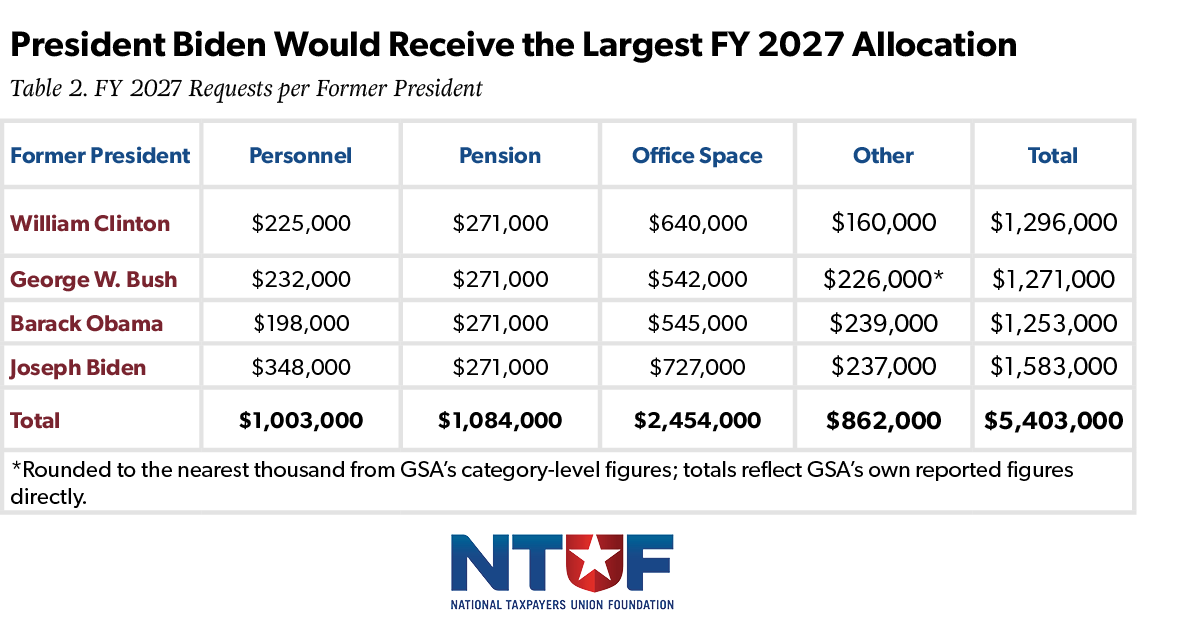
Under GSA’s FY 2027 budget request, all former presidents receive the same $271,000 annual pension. Differences in their overall support primarily reflect office and personnel costs. Biden has the largest proposed allocation, totaling $1.583 million, including $727,000 for office rent. By comparison, the requested rental payments are $640,000 for Clinton, $545,000 for Obama, and $542,000 for Bush. Biden also served in the Senate for 36 years, with that and his time as Vice President making him eligible for a separate congressional pension with a starting amount of up to $166,374.
There is no statutory limit on either the size of a former president’s office or the amount taxpayers must pay for rent subsidies. The office rental is the single largest line item by a wide margin at $2.454 million, more than double the $1.084 million spent on all four pensions combined and accounting for roughly 45 cents of every dollar in the request. The amount spent on office space grew nearly 16% in two years (FY2025 to FY2027), a pace far outrunning the roughly 5–6% cumulative inflation over the same period.
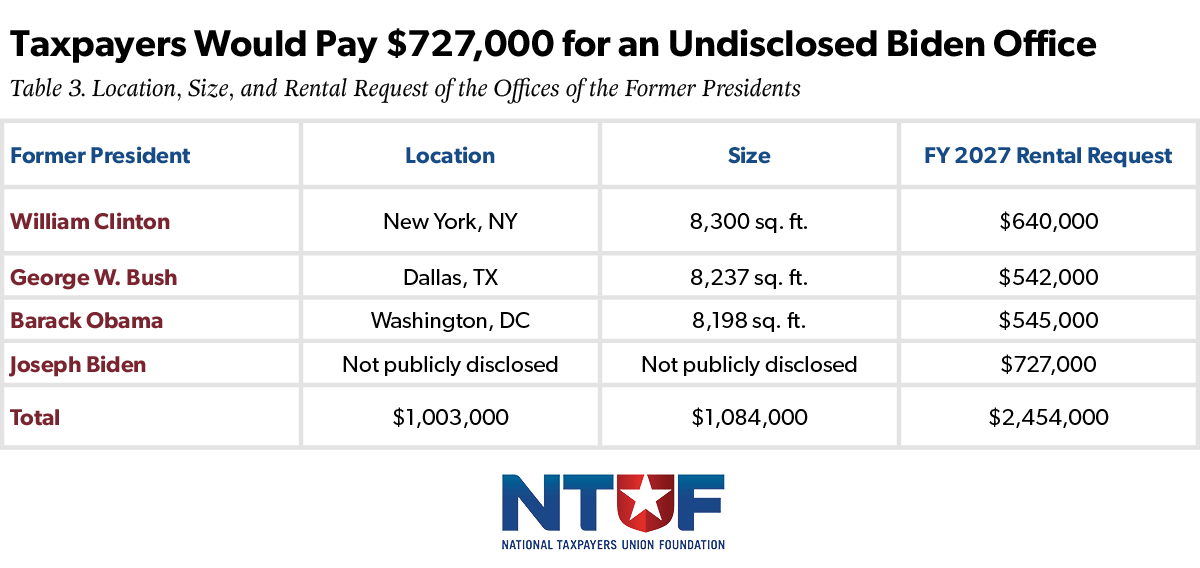
GSA’s FY 2027 budget justification includes funding for former President Biden’s office, but does not identify its location or square footage. GSA has not responded to multiple NTUF inquiries seeking this information. This lack of transparency is ironic given that one of the original rationales for providing these taxpayer-funded benefits was to assist Truman with the large volume of public correspondence he received after leaving office. Taxpayers are now funding an office intended to partly assist former presidents with their public correspondence, yet there is a lack of public disclosure of even its mailing address.
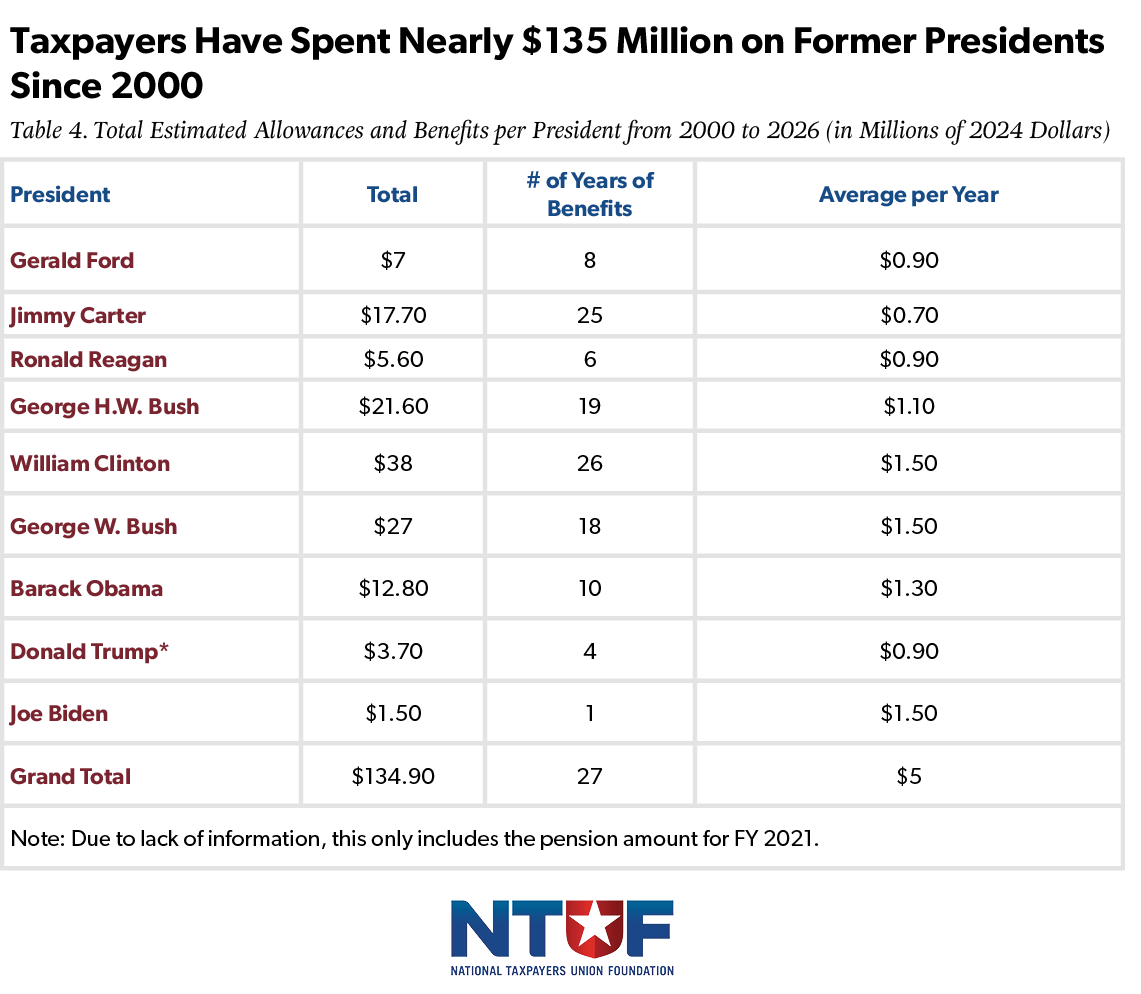
From 2000 through 2026, taxpayers provided an estimated $134.9 million in allowances and benefits to former presidents, measured in 2024 dollars. Clinton has received the largest cumulative total at $38 million, followed by George W. Bush at $27 million. Trump’s $3.7 million total is understated because the available FY 2021 data include only his pension, rather than the full range of benefits.
From Truman’s Reported Hardship to Benefits for Millionaires
The concerns extend beyond how these benefits are administered to the rationale on which they were established. Congress enacted the Former Presidents Act in 1958 following claims that Truman, who had left office five years earlier, was experiencing financial difficulties in addition to struggling with correspondence and speaking requests.
However, estate records released after the death of his wife, Bess, presented a different picture. A subsequent analysis of the documents found that the Trumans had considerable wealth at the time proponents of the FPA argued that he was facing hard times. His wealth in 1958 amounted to over $90 million in current dollars. This revelation raises questions about whether the permanent taxpayer-funded benefits package was justified by the facts.
This discovery also raises concerns about an important distinction between providing limited assistance to close out an administration in the Presidential Transition Act as compared to lifetime office perks for a former president’s office. Modern former presidents have accumulated considerable personal wealth and can earn millions of dollars through book deals, speaking engagements, media agreements, and other private ventures. Nevertheless, the federal government continues paying for their pensions and offices without regard to their income, wealth, or the number of years they have been out of office.
According to estimates, living former presidents’ net worths range from roughly $10 million (Biden) to $40 million (G.W. Bush), $70 million (Obama), and $120 million (Clinton). Biden’s recent memoir deal further illustrates this trend, with the former president reportedly securing an advance of roughly $10 million from Hachette Book Group for his presidential memoir. Additionally, Donald Trump’s estimated net worth stands at approximately $5.4 billion, making him the wealthiest president in U.S. history.
Modernizing the Former Presidents Act
Congress came close to reforming these benefits a decade ago. The House passed the Presidential Allowance Modernization Act of 2016 by voice vote. The Senate subsequently approved a version by unanimous consent with some amendments for clarity that the House agreed to. The legislation would have capped the presidential pension and replaced the existing assortment of office and staffing benefits with a limited annual allowance.
Despite this broad bipartisan support, President Barack Obama vetoed the legislation in July 2016, months before the conclusion of his second term, claiming that the bill could abruptly terminate salaries and benefits for former presidents’ employees and interfere with existing office leases.
Senator Joni Ernst (R-IA) introduced the latest version, the Presidential Allowance Modernization Act of 2025. The bill would establish a $200,000 annual pension and a separate annual allowance of up to $200,000, with both amounts indexed to inflation. It would replace the existing authorization for taxpayer-funded office space, staff, and related expenses with the new allowance.
The expense allowance would be reduced by one dollar for every dollar that a former president’s adjusted gross income and tax-exempt interest exceed $400,000. It would not alter Secret Service protection or related security funding, and an exception would preserve funding that GSA and the Secret Service determine is necessary to cover costs arising from security requirements.
The current proposal would apply only to presidents who become former presidents after its enactment. It therefore would not change the benefits provided to individuals who were already former presidents when the bill became law. The legislation would also increase the annual benefit for a surviving spouse from $20,000 to $100,000 and index it to inflation.
The Congressional Budget Office has not yet published a cost estimate for the latest version of the bill. Its most recent estimate for a similar proposal in 2019 found that the reform would reduce outlays by $2 million over five years.
Further savings could be achieved by setting a time limit on the availability of the office expense for current as well as future former presidents. Such a limit would preserve support without requiring taxpayers to subsidize office expenses indefinitely.
Additional transparency measures could require GSA to annually disclose each office’s location, square footage, lease costs, and a better accounting of other expenditures each year, subject to security considerations. Although GSA’s annual budget justification breaks down the proposed funding for each former president and expense category, its reporting of prior-year enacted funding only shows the combined total for all former presidents. Occasionally, the Congressional Research Service has compiled this spending data by president, but not since 2016. The GSA should provide annual accounting of actual expenditures by president and category, which would allow Congress and taxpayers to compare what was requested, appropriated, and ultimately spent.
The respective offices of each former president should also provide sufficient transparency to distinguish between work related to a former president’s public duties and work supporting paid speeches, book projects, or other private ventures. This would help ensure that taxpayer dollars are used appropriately and not to create further wealth-building opportunities for already wealthy former presidents.
Conclusion
GSA’s FY 2027 budget request seeks more than $5.4 million for former presidents’ benefits, including approximately $2.5 million for office space. With the federal debt now exceeding $40 trillion, Congress should find ways to reduce unnecessary spending, including perks that subsidize millionaires. Over the years, Congress has enacted reforms to rein in its own pension system and put an end to office perks that had been provided to former speakers of the House. Given the false premises upon which the Former Presidents Act was enacted, it is time to reform perks for former presidents.
Senator Ernst’s commonsense Presidential Allowance Modernization Act would reform the existing benefits with more limited pensions and expense allowances for future former presidents.
Congress could achieve additional savings by extending reforms to current former presidents and placing a time limit on taxpayer-funded office expenses. Such a limit could preserve short-term administrative support without requiring taxpayers to subsidize permanent office benefits for a very exclusive group of wealthy private citizens.